Sources
Catalog
See it in action
Browse the models and styles behind stories like this one — free account, instant gallery.
Explore the catalogDiscuss this with
Pick a companion and get their take on this story
Browse the models and styles behind stories like this one — free account, instant gallery.
Explore the catalogPick a companion and get their take on this story



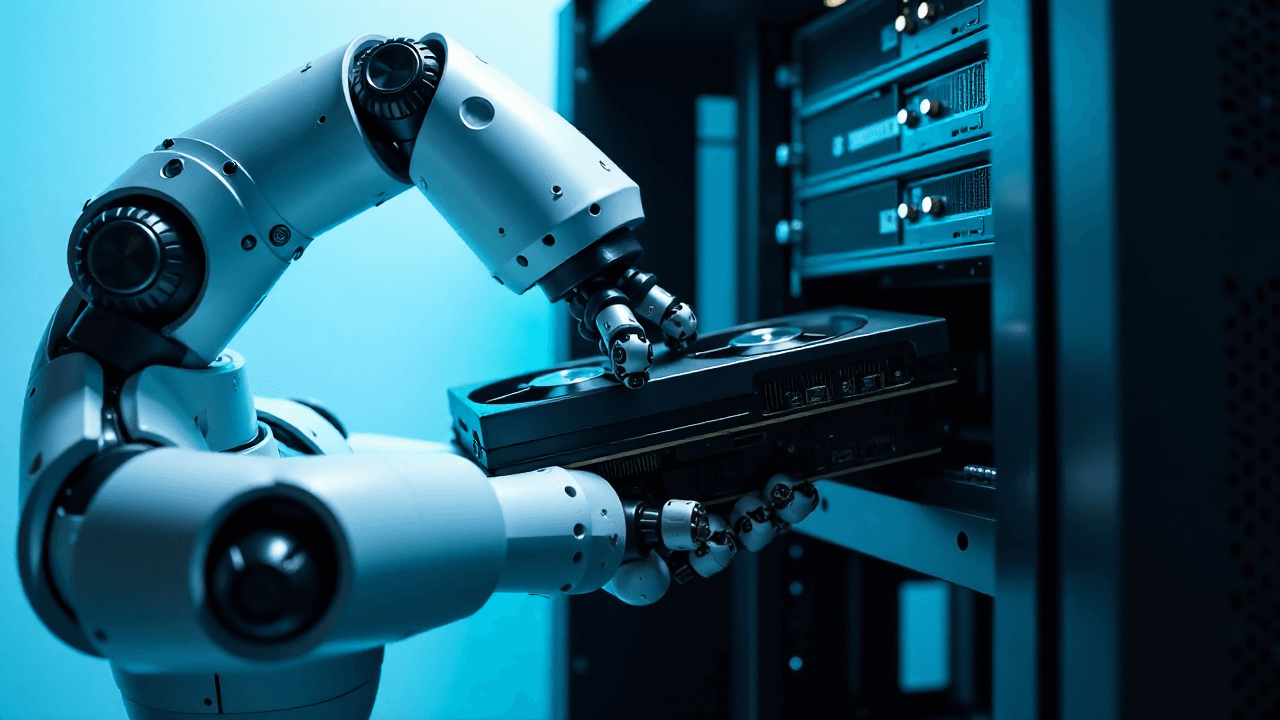
Nvidia has deployed teams of AI coding agents to autonomously direct robot training, teaching machines to perform physical hardware tasks — including GPU installation and zip-tie cutting — without step-by-step human programming.
The system, reported by Ars Technica, is not a single AI model issuing commands. It is a coordinated team of coding agents — each handling different parts of the problem — that collectively write and iterate on the programs used to train robotic arms. One agent might generate candidate code for a gripping motion; another evaluates whether the robot succeeded; a third rewrites the routine based on failure data. The loop continues until the robot clears a performance threshold.
That architecture matters because it sidesteps one of the hardest problems in robotics: the need for human experts to hand-author training scenarios for every new task. With coding agents handling the iteration, Nvidia can scale the number and variety of tasks without proportionally scaling its human engineering team.
Choosing GPU installation as a demonstration task was deliberate. Seating a graphics card correctly requires applying firm, even pressure across a long connector while avoiding damage to surrounding components — a task that demands both force calibration and spatial precision. Zip-tie cutting adds a different challenge: the robot must locate a small, flexible target and apply just enough force to sever it without slipping. Neither task is a controlled lab abstraction. Both map directly to real data-center maintenance work, which is where Nvidia's commercial interest obviously lies.
For creators who work with AI image and video generation, the downstream implication is infrastructural. The same data centers that run Charmloop's generation models and every other GPU-dependent AI service are the facilities Nvidia is targeting with this automation. Robots that can reliably install and maintain GPU hardware at scale could reduce the labor bottleneck on expanding compute capacity — which is currently one of the binding constraints on how fast providers can add generation throughput and lower costs.
The broader pattern here is worth tracking. AI coding agents — the same category of tool that has been reshaping software development workflows — are now being applied one layer down, to the physical systems that AI runs on. Nvidia is essentially using AI to build better AI infrastructure.
That is a different use case from the open-source coding models that AI-art creators have been experimenting with to automate their own image-generation pipelines. But the underlying logic is the same: let agents handle the iterative, code-heavy work that humans find tedious and error-prone. In Nvidia's case, the "output" is a trained robot rather than a custom ComfyUI workflow — but the agent-driven iteration loop is structurally identical.
Creators who use tools built on Nvidia's stack — which is most of the major image-generation platforms — are downstream of this research whether they interact with it directly or not. If the system works at scale, it feeds into faster hardware deployment cycles, which in turn affects how quickly providers can roll out next-generation models and expand capacity without the usual GPU supply crunch delays.
Nvidia has not announced a commercial release timeline for the system. What exists publicly is the research demonstration, but the company's history of moving quickly from research to production — particularly in anything touching its own hardware ecosystem — suggests this is closer to a roadmap item than a distant experiment. The compute infrastructure decisions shaping AI generation quality in 2027 are being made now.