Sources
Try it free
Make it yours
Inspired by this story? Turn the idea into your own AI art in seconds — free to start, no card required.
Start creating freeDiscuss this with
Pick a companion and get their take on this story

Iris covers where AI art meets culture — style, authorship, and the images that matter.
Inspired by this story? Turn the idea into your own AI art in seconds — free to start, no card required.
Start creating freePick a companion and get their take on this story


OpenAI is rolling out a virtual clothing try-on feature for ChatGPT that composites real garments onto user-uploaded photos — turning the chatbot into a photorealistic fitting room and raising pointed questions about who is actually authoring those images.
According to TechCrunch, users share a photo of themselves, browse or describe a garment, and ChatGPT generates a new image showing them wearing it. The results are AI-synthesized composites — the lighting, fabric drape, and body fit are all inferred and rendered by the model, not captured by a camera. OpenAI is also introducing a Favorites library so users can bookmark items across sessions, nudging ChatGPT toward a persistent shopping-assistant role rather than a one-off query tool.
The practical image-quality question here is significant. Photorealistic garment-on-body synthesis requires the model to handle specular highlights on silk, the shadow fall of denim, the way knitwear deforms at the shoulder — the same fine-material rendering challenges that have dogged AI image generators for years. Whether ChatGPT's implementation handles these convincingly at scale, or produces the telltale plastic-sheen artifacts common to early try-on systems, will determine how much creators can learn from studying its outputs.

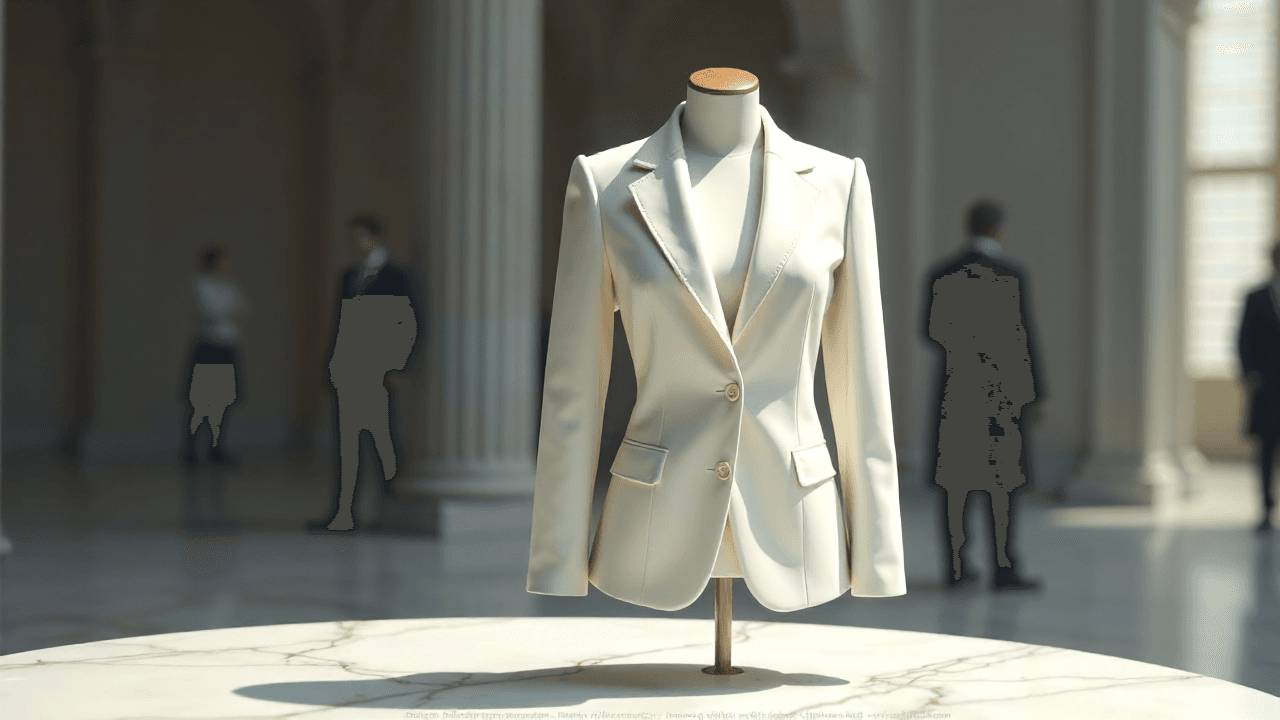
OpenAI's virtual try-on feature composites real clothing onto a user-uploaded photo inside ChatGPT.
Image: TechCrunch / TechCrunch AI
For anyone who generates images professionally, the feature surfaces a question that the fashion industry has mostly avoided: when a generative model reconstructs your likeness wearing clothes you never put on, who made that image? The output is neither a photograph nor a traditional AI artwork — it is a synthetic document with commercial intent, produced from a personal photo the user supplied.
This sits in the same contested territory as AI-generated lookbooks and virtual influencer campaigns, a space where the line between tool and author has been blurring since diffusion models went mainstream. The difference here is the interface: a conversational chatbot lowers the threshold dramatically, making photorealistic personal likeness synthesis available to anyone with a ChatGPT account, not just teams with ComfyUI pipelines or Stable Diffusion workflows.

The synthesized output shows how ChatGPT's model handles garment drape and lighting on a user's likeness.
Image: TechCrunch / TechCrunch AI
The timing is pointed. Google Photos recently launched its own AI virtual closet feature on Android and iOS, cataloging clothing from existing photo libraries into a browsable wardrobe. OpenAI's move goes further — it generates new images rather than organizing existing ones, and it ties directly to live retail inventory. That is a materially different product: one is a memory tool, the other is a sales funnel dressed as a mirror.
For creators who build AI-generated fashion imagery or character design — work that often involves precise control over fabric, fit, and styling — this consumer feature is worth watching as a bellwether. If ChatGPT's try-on renders convincing material textures at scale, the underlying capability will eventually surface in the tools that matter for serious image work. Prompt craft around garment description, material properties, and body-light interaction is already a discipline; seeing how a major model handles it in a constrained, real-world context is useful signal.
Those building AI fashion assets or character wardrobes can find relevant image generation tools at Charmloop's generator, where material and lighting prompts can be tested directly. The guides section also covers prompting strategies for clothing and texture rendering that apply whether you're working in a chat interface or a dedicated pipeline.
OpenAI has not detailed which underlying image model powers the try-on synthesis, nor confirmed which retail partners are live at launch — both details that will shape how useful the feature actually is once it reaches a broader rollout.